


As our library continues to expand, we have introduced a dedicated entry for Certifications and Ratings. Given the breadth and complexity of this topic, providing an exhaustive catalog of every available certification, rating, or benchmark would offer limited value to most readers. Instead, this section focuses on the most influential approaches shaping market practice today, alongside access to specialist guidance where more tailored support is required.
Recognizing the complexity of this area, we are directing users to one of our subject-matter team members, a specialist with deep, practical experience in navigating, selecting, and implementing the most relevant standards, certifications, and ratings:
Richard Betts
RZB Advisory
Richard.betts@rzbadvisory.com
Richard's advice to our readers is that "in practice, organizations rarely rely on a single standard or certification. The key is understanding how these frameworks interact and which are most relevant to your assets, investors, and regulatory context."
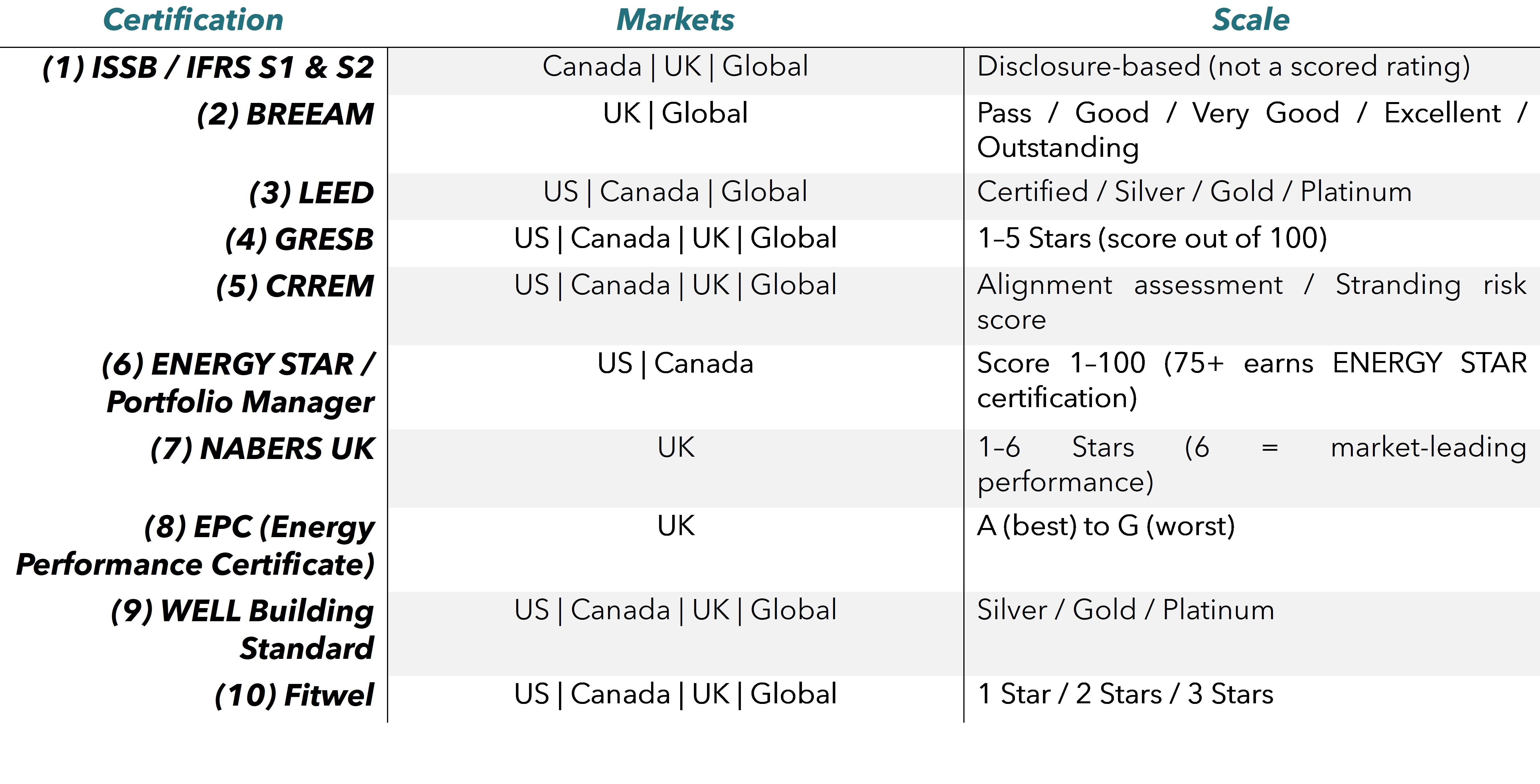
To provide support, we summarize in this post a selection of key certifications and ratings that most directly influence investment decisions, regulatory compliance, and asset performance across the built environment. While not a certification or rating, standards such as those from the ISSB are included, given their role in establishing the global baseline for sustainability-related financial disclosure and their increasing influence on how assets are assessed, managed, and reported.
1. ISSB / IFRS S1 & S2 (International Sustainability Standards Board) | https://www.ifrs.org/groups/international-sustainability-standards-board
Type: Standard ESG Focus: Governance / Reporting Framework Primary Use: UK, Canada, Global
The ISSB, created by the IFRS Foundation in 2021, is establishing a global framework for sustainability‑related financial disclosures. In 2023 it released its first two core standards - IFRS S1 for general sustainability risks and opportunities, and IFRS S2 for climate‑related disclosures, which incorporates the TCFD recommendations. As of April 2026, more than 35 jurisdictions representing over 55% of global GDP have already adopted or started to adopt them including Canada and the UK.
Importantly for the real estate sector, the ISSB’s industry‑based metrics draw on industry-based metrics, including those aligned with frameworks such as from the GRESB Real Estate Assessment, which is explicitly cited throughout the guidance as a normative reference.
ISSB is rapidly emerging as the global baseline for investor‑grade ESG reporting, effectively succeeding TCFD as the primary governance and climate disclosure framework for capital markets in many places.
2. BREEAM | https://breeam.com
Type: Certification ESG Focus: Environmental Primary Use: UK, Europe
BREEAM is widely recognized as one of the world’s longest‑standing and most widely adopted building sustainability certification, established by BRE in the UK in 1990. It provides a comprehensive assessment framework spanning energy performance, water efficiency, occupant health and wellbeing, materials, waste, ecological impact, and overall management practices. Certifications are conducted exclusively by licensed independent assessors. Market analyses generally show that BREEAM‑certified assets achieve notable financial advantages.
3. LEED (Leadership in Energy and Environmental Design) | https://www.usgbc.org/leed
Type: Certification ESG Focus: Environmental Primary Use: US, Canada, Asia
LEED, introduced by the U.S. Green Building Council (USGBC) in 1998, is one of the most widely adopted green building certification system, with more than 190,000 certified projects across 186 countries. It maintains a particularly strong footprint in the United States, Canada, and major international markets.
The system provides a structured, third‑party–verified framework - administered through the Green Business Certification Inc. (GBCI) review process - in which project teams document performance across key sustainability domains including energy, water, materials, indoor environmental quality, and sustainable site development.
Market evidence from CBRE and Cushman & Wakefield shows that LEED‑certified assets consistently outperform peers, with certified buildings achieving an average 3.7% rental premium, and Class A office properties realizing sales premiums of up to 25.3% per square foot (CBRE’s 2022 report “Green Is Good: The Enduring Rent Premium of LEED-Certified U.S. Office Buildings” and Cushman & Wakefield’s “Green Is Good” research spotlight - Part 2).
4. GRESB (Global Real Estate Sustainability Benchmark) | https://www.gresb.com
Type: Benchmark ESG Focus: Portfolio / Governance Primary Use: Global — used by institutional investors
GRESB, founded in 2009, is the leading investor‑driven ESG benchmark for real estate portfolios and funds, used by more than 1,500 property companies, REITs, and investment managers worldwide. Its assessment framework evaluates management practices, strategy, risk oversight, energy and GHG performance, water and waste management, tenant engagement, and broader social impact.
The methodology is closely aligned with major global standards and initiatives - including ISSB, GRI, the Paris Agreement, and the UN SDGs - ensuring consistency with institutional investor expectations. As a result, GRESB has become widely regarded as a leading global benchmark for ESG reporting in the real estate sector, with many pension funds and sovereign wealth funds now requiring participation as a condition of capital allocation.
5. CRREM (Carbon Risk Real Estate Monitor) | https://crrem.org/
Type: Initiative ESG Focus: Environmental / Governance Primary Use: Europe (originated), Global (now)
CRREM is an EU‑developed tool that has since gained global adoption as a leading method for assessing carbon‑stranding risk within real estate portfolios. It provides science‑based decarbonization pathways aligned with the Paris Agreement and the Science Based Targets initiative (SBTi), enabling owners and investors to understand whether individual assets remain on a Paris‑aligned trajectory.
Institutional investors are increasingly using CRREM outputs to support SFDR compliance and to evidence transition‑risk management. By identifying which properties are at risk of becoming “stranded” without significant retrofit investment, CRREM has become a critical input to long‑term capital allocation decisions across U.S., Canadian, and UK real estate portfolios.
6. ENERGY STAR / Portfolio Manager | https://www.energystar.gov
Type: Benchmark ESG Focus: Environmental Primary Use: US, Canada
ENERGY STAR is a U.S. EPA program that benchmarks building energy performance against comparable assets, providing a nationally recognized measure of operational efficiency. Its Portfolio Manager platform is the dominant benchmarking tool for U.S. commercial real estate and is a mandatory component of GRESB reporting as well as many local Building Performance Standards.
The program requires 12 consecutive months of verified utility data and is widely adopted across both the U.S. and Canada. ENERGY STAR benchmarking is also foundational for compliance with major city‑level disclosure and performance ordinances, including those in New York, Chicago, and Toronto, making it an essential element of regulatory and investor‑grade energy reporting for building owners.
7. NABERS UK (National Australian Built Environment Rating System) | https://www.nabers.gov.au/about/nabers-international/nabers-uk
Type: Rating ESG Focus: Environmental Primary Use: UK (commercial offices)
NABERS UK is an operational energy performance rating system adapted from Australia’s NABERS framework and now administered by CIBSE. It is the only UK certification that measures actual, in‑use energy performance rather than design intent - a key distinction from BREEAM and EPCs.
The system is gaining rapid adoption among major institutional landlords, with leading owners such as British Land, Landsec, and Grosvenor publicly committing to its use. NABERS UK ratings are also directly recognised within GRESB scoring, strengthening their relevance for investor‑grade ESG reporting.
Its Design for Performance (DfP) pathway embeds energy‑use targets from early design through project completion, helping ensure new developments deliver on their operational performance commitments.
8. EPC (Energy Performance Certificate) / MEES
Type: Rating ESG Focus: Environmental / Regulatory Compliance Primary Use: UK — mandatory for all commercial property
EPCs are a mandatory UK legal requirement for all commercial buildings at the point of construction, sale, or lease. Under the Minimum Energy Efficiency Standards (MEES), it is unlawful to let a property with an EPC rating below E, with substantial penalties for non‑compliance. The regulatory trajectory is tightening: a minimum EPC C will be required from 2027 and a minimum B from 2030.
EPCs are based on design‑stage modelling rather than actual operational performance, but they remain a core regulatory requirement for every UK property owner and investor, underpinning transactions, leasing strategy, and long‑term asset planning.
9. WELL Building Standard | https://www.wellcertified.com
Type: Standard ESG Focus: Social / Health & Wellbeing Primary Use: Global — offices, healthcare, education
WELL, developed by the International WELL Building Institute (IWBI), is a leading global certification focused exclusively on occupant health and wellbeing. Its framework evaluates performance across ten core concepts: air, water, nourishment, light, movement, thermal comfort, sound, materials, mind, and community.
Adoption has accelerated rapidly, with strong uptake across office, healthcare, and education sectors. WELL‑certified environments are increasingly sought after by tenants prioritizing employee wellness, and evidence consistently links WELL‑rated spaces to higher tenant satisfaction and stronger retention outcomes.
10. Fitwel | https://www.fitwel.org
Type: Certification ESG Focus: Social / Health & Wellbeing Primary Use: US, Canada, UK
Fitwel, created in 2017 by the U.S. Centers for Disease Control and Prevention (CDC) and the General Services Administration (GSA), is a health‑focused building certification that advances occupant wellbeing through evidence‑based design, operational practices, and organizational policies. Positioned as a more accessible and cost‑effective alternative to WELL, it has seen strong international uptake.
Fitwel participation contributes positively to GRESB scoring, further embedding it within institutional ESG reporting frameworks.
Disclaimer: SAM Curated, the curators and any other guests invited to share their opinions assume no responsibility or liability for any errors or omissions in the content of this site and/or email generated by this site. Please note that the information on this site is provided on an “as is” basis, with no guarantees of completeness, accuracy, usefulness or timeliness.